
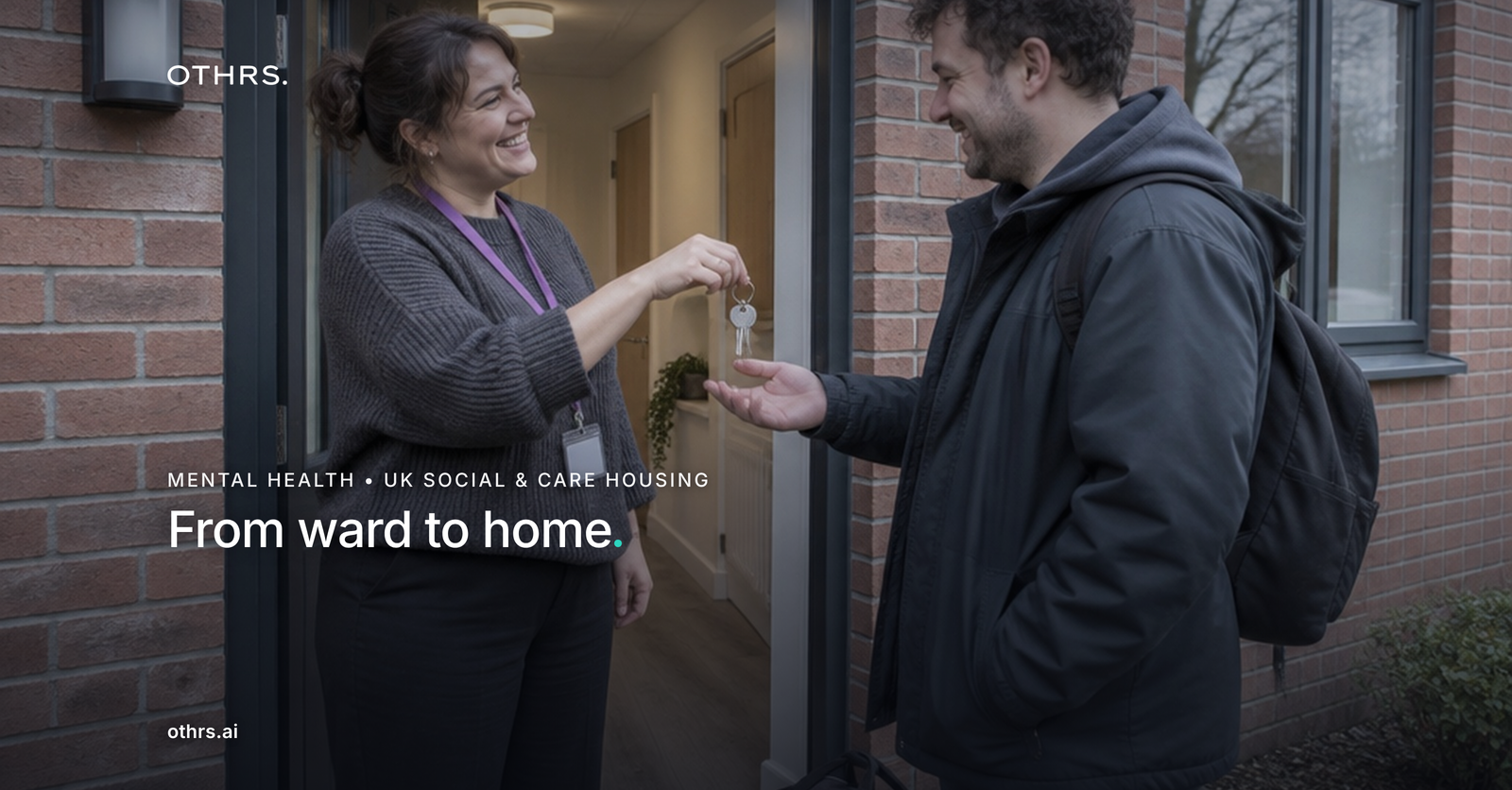
Few things hold up a person's recovery like having nowhere suitable to go. In mental health services, people who are clinically ready to leave hospital can be kept waiting for the right housing, and every day of that wait is a day in a ward bed that someone else may need. Supported housing for mental health is the bridge between a hospital stay and an independent life, and it is under real pressure.
This guide explains how mental health supported living works in England, who is responsible, what changed in 2026 and what the evidence says about delays. It is educational, not legal advice.
What it is
The Care Quality Commission distinguishes supported living, where accommodation and personal care are arranged separately and the person can choose another care provider, from a care home, where accommodation and care come together from one provider. Supported living may then need registration only for the personal care activity. NHS England commissioner guidance on community mental health rehabilitation says housing is regularly the main barrier to discharge for people with rehabilitation needs, and notes that a CQC rating for a supported living service may reflect only the regulated activities rather than the whole service.
Who has to provide what: section 117 aftercare
Section 117 of the Mental Health Act 1983 places a duty on the integrated care board and the local social services authority to provide aftercare to people who have been detained under section 3, or under certain court orders and directions, once they leave hospital. The duty continues until both authorities agree the person no longer needs the services. The services must meet a need arising from the person's mental disorder and reduce the risk of their condition worsening, and the responsible authority follows ordinary residence rules.
The Local Government Association says aftercare under section 117 cannot be charged for, and that while ordinary housing is not aftercare, specialist accommodation that meets mental health needs can be funded as aftercare where the test is met. Because that guidance comes from the LGA rather than from the Act itself, anyone relying on it should confirm the position with their council and ICB.
What changed with the Mental Health Act 2025
The Mental Health Act 2025 received Royal Assent in December 2025. Sections 51 and 52 took effect on 6 April 2026, and section 51 treats certain private registered providers as public authorities under the Human Rights Act when they provide section 117 aftercare. A further amendment to section 117, which will require written notice to the person of aftercare responsibilities and set ordinary residence rules, has been passed but is not yet in force and has no commencement date. Check commencement before relying on any single provision.
Entitlement to assessment
People with mental health needs can also be assessed under the Care Act 2014. The eligibility test applies to needs arising from a physical or mental impairment or illness, and requires an inability to achieve 2 or more of 10 outcomes with a significant impact on wellbeing.
What the evidence says about delay
A 2026 report, Breaking the Cycle, by Look Ahead with the Royal College of Psychiatrists and the National Housing Federation, says that delayed discharges due to housing caused 121,695 additional mental health bed days in 2024 to 2025, costing the NHS around £102m. It reports that in February 2026 patients waiting for supported housing accounted for 23% of all mental health delayed discharge days. The bed days come from NHS Digital statistics and the cost from the NHS England National Costing Collection, but the report does not explain how the £102m was calculated, so treat it as the report's estimate, not an official figure.
5 things that help a placement work
- Start housing planning at admission. Do not wait until discharge is imminent.
- Be clear who funds what. Agree whether section 117 applies and which authority is responsible.
- Match the person to the scheme. Share a clear picture of needs, risk and preferences with the provider.
- Keep the tenancy and care separate. It protects the person's home if care needs change.
- Plan the move on. Agree what happens as the person recovers.
How OTHRS helps
Delay often comes from the same cause: the right information is not in front of the right person at the right time. OTHRS is being built so that local authorities can publish the demand they have, so that providers can see opportunities that fit their registered services and areas, and so that housing providers and developers can show verified schemes. Every match is meant to show its reasoning, and the conversation and the agreement sit in one Deal Room. It does not replace clinical or social work judgement, and it does not place individuals.
Frequently asked questions
What is mental health supported living?
Housing where the person has their own home and receives support arranged separately, helping them recover and live independently after or instead of hospital care.
What is section 117 aftercare?
A duty on the ICB and local authority to provide aftercare services to people who have been detained under certain sections of the Mental Health Act, once they leave hospital.
Is section 117 aftercare free?
The LGA says it cannot be charged for. Confirm the position with your council and ICB.
What is the cost of delayed discharge for lack of supported housing?
A 2026 sector report puts the NHS cost of housing related delayed discharges in mental health services at around £102m in 2024 to 2025. It is the report's estimate, not an official figure.
Did the Mental Health Act 2025 change aftercare?
Parts have taken effect and one amendment to section 117 is still awaiting commencement.
Help the right home find the right person sooner. Sign up at othrs.ai.
Sources
- CQC, accommodation for persons who require nursing or personal care
- Mental Health Act 1983, section 117
- Mental Health Act 2025, section 46
- Mental Health Act 2025 (commencement) regulations 2026
- Local Government Association, legal framework on section 117
- NHS England, commissioner guidance on adult community mental health rehabilitation services
- Look Ahead, Breaking the Cycle report
- Care and Support (Eligibility Criteria) Regulations 2015, regulation 2
- GOV.UK, Housing Benefit for supported housing and exempt accommodation