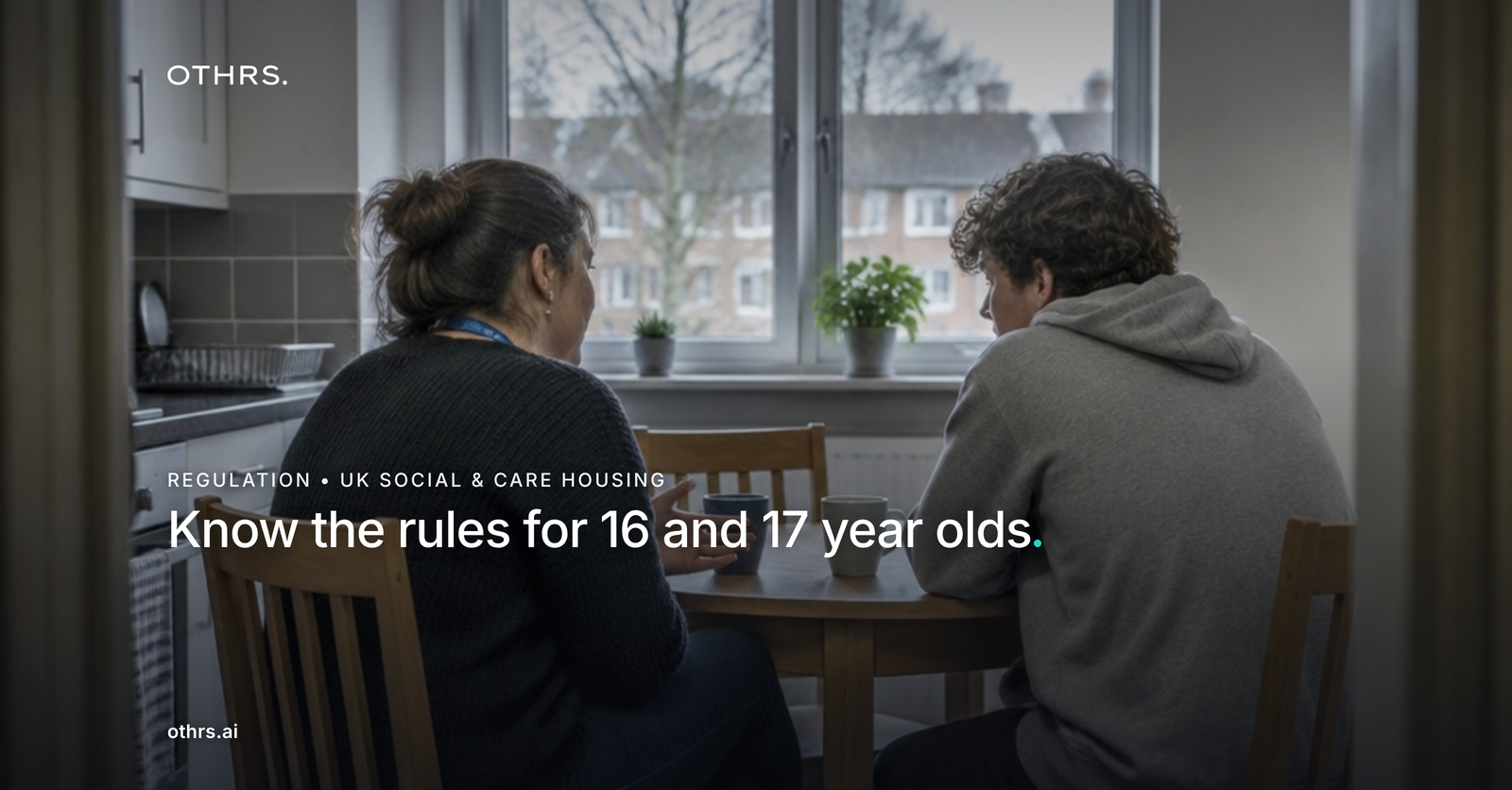
For years, a looked after 16 or 17 year old could be placed in accommodation that nobody inspected. That changed in 2023. If you provide, commission or invest in accommodation for this age group, Ofsted is now the regulator that matters, and the rules are different from the CQC and Regulator of Social Housing regimes that most supported housing providers know.
This guide covers what the regime is, who it applies to, what providers must do and how the market looks. It is educational, not legal advice, and Ofsted guidance is under review, so always check the current pages before you act.
What the regime covers
The Supported Accommodation (England) Regulations 2023 apply to supported accommodation for looked after children and care leavers aged 16 and 17 that a local authority arranges. Ofsted began accepting applications from 28 April 2023, providers had until 28 October 2023 to apply, and operating without an application accepted as complete is now an offence.
The Department for Education guide is clear on the limits. The regulations do not cover adults aged 18 and over, although a setting that also houses under 18s must still comply for them. Children under 16 should not be in this type of accommodation. And the guide does not expect supported accommodation to suit children with complex needs who are better served by a children's home or foster care.
The 4 quality standards
The regulations set 4 standards: leadership and management, protection, accommodation, and support. Providers must also keep a statement of purpose and maintain a workforce plan.
Registration in practice
- Ofsted registers the service, not each building. A provider registers the service and must tell Ofsted the address of each setting before operating it.
- The registered manager is registered personally. The registration cannot be transferred. Each manager applies and pays a fee, and Ofsted must be satisfied that they have the skills, knowledge and experience to meet the registration requirements.
- Organisations appoint a nominated individual. This person represents the organisation and is Ofsted's point of contact.
- Fitness tests apply. They cover integrity and good character, skills and experience, and physical and mental fitness.
How inspection works
Ofsted inspects against the social care common inspection framework for supported accommodation. It does not use a graded scale. It gives one of 3 outcomes, and each sets the timing of the next inspection:
- Outcome 1. Consistently strong service delivery. Next inspection in about 3 years.
- Outcome 2. Inconsistent quality that adversely affects some children. Next inspection in about 18 months.
- Outcome 3. Serious or widespread weaknesses. Next inspection in about 6 months.
Every provider is inspected at least once in a rolling 3 year window. Enforcement tools include requirements, compliance notices, conditions, and restriction or suspension of the service.
Where the market stands
As at 31 March 2026, Department for Education statistics recorded 1,220 active or suspended providers, 9,350 open or pending premises and 24,700 places. The number of providers was up 37% from 890, and 88% were privately owned. By 30 April 2026, only 210 providers (17%) had a published full inspection outcome. Of those, 45% received outcome 1, 48% outcome 2 and 7% outcome 3.
The law is also moving. The Children's Wellbeing and Schools Act 2026 received Royal Assent in April 2026 and, according to Department for Education policy notes, gives Ofsted power to fine children's social care providers for breaches of the Care Standards Act 2000, including unregistered providers. The notes do not say how this applies to supported accommodation, so check the detail and the commencement dates before relying on any single provision.
How OTHRS helps
For a commissioner or investor, the question is rarely whether a provider says it is registered, but whether it is. OTHRS is being built to check organisations against public registers, including Ofsted where relevant, and to show that status on a verified profile. That gives a commissioner a quicker first filter and gives a provider a way to be found with its registration visible. It supports the decision. It does not replace reading the inspection report.
Checklist
- Confirm which regulator covers each service you run or commission.
- Confirm the age range of every resident, including any under 18s in mixed settings.
- Check the registration status and the latest inspection outcome.
- Check the registered manager and nominated individual are in post.
- Keep your statement of purpose and workforce plan current.
Frequently asked questions
Who has to register with Ofsted?
Providers of supported accommodation for looked after children and care leavers aged 16 and 17 that a local authority arranges.
When did registration start?
Applications opened on 28 April 2023, with an application deadline of 28 October 2023.
How many quality standards are there?
4: leadership and management, protection, accommodation, and support.
How is supported accommodation inspected?
Against a social care common inspection framework, with 3 outcomes that set the next inspection at about 3 years, 18 months or 6 months.
Does it cover care leavers over 18?
No. Adults aged 18 and over are outside the regulations.
Be found with your registration visible. Sign up at othrs.ai.
Sources
- Ofsted: registering a supported accommodation service
- Ofsted registration policy
- Ofsted announcement on registration, applications from 28 April and application deadline 28 October 2023
- Supported Accommodation (England) Regulations 2023
- DfE guide to the regulations and quality standards
- Ofsted inspection framework for supported accommodation
- Children's social care in England 2026, main findings
- DfE policy summary notes, Children's Wellbeing and Schools Act